Blog Archive

Showing posts with label thoughts. Show all posts

Sunday, 31 January 2016

Stop the Clock

Ideas and Opinions | Milo

In this piece I am defending the right to live a thoughtful life, and that "thinking" at the expense of "doing" is not only OK but is a necessity of living in the "first world". Milo out.
 
work-in-progress
Image from John Saddington
Humanity marches forward right? That's what it does, we progress, we march, we improve on the works of our fathers and seek absolution from the sins of our fathers, ultimately improving all the same. Indeed in this world of unflinching progress, where we will forgive athletes all manner of abuses because they are great, and we will forgive musicians all number of obscenities because we adore them, and ignore other such billionaires because they are our leaders and benefactors, there is no time for anything other than progress. 

You're a bum if you are working in the same modest job for fifteen years, and you're a loser if you are unemployed. We are raised with the expectation that we will inevitably hate our jobs, and some of the most popular sitcoms of our time deal with the awkward mishmash of necessity, and incompatible personalities, that make a 9-to-5 the biggest bane of the (hideously named) "first world".
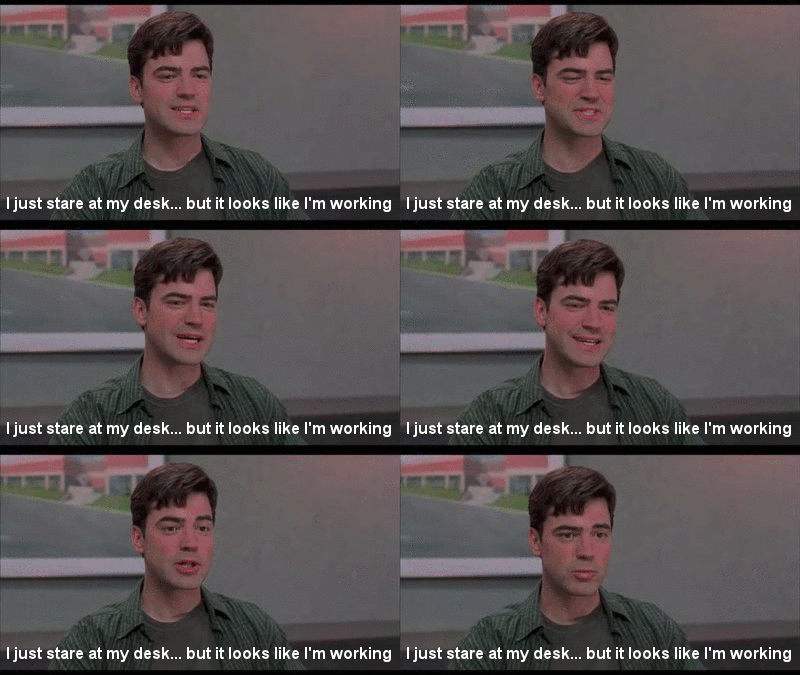
Working
Office Space Gif
If I was to stroll through London I would be bashed and bruised, knocked aside by the hundreds of busy, busy people all participating in this culture of progress. No one seems to have time these days, despite time being all we have as people of the "first world".

It is with this perspective that I seek to stop the clock. After all it is "our" clock to stop isn't it? We have stopped many a clock in the past, such as when sundials were deemed inefficient, and then we stopped even more when trains required a standardised time to run smoothly.

So there, I've stopped the clock.

When I miss my bus stop because I am reading a novel: I have stopped the clock. When I live a monkish existence rather than rush into my next job: I have stopped the clock. When I take an hour to decide whether I want to wake up, or stay in bed for a further hour: I have stopped the clock.

However aside from these petty rebellions against our busy and "progressive" society, there is a more meaningful reason to stop the clock. We in the UK speak the world's most convenient-to-speak language. We live in "our" world, and with that comes a sense of stewardship and compassion that cannot be expected of those "outside" of it. We are charged with thinking about how best to live, because our actions have consequences for hundreds upon thousands of other people. Right now how I choose to value myself as a worker affects those who I will work with, and those who will benefit from my employment. Moreover the attitudes I have will affect my ability to live with my neighbours in peace. This goes from the insignificant (like deciding whether to have patience with the noise of a neighbours DIY) to the significant (like deciding ones perspectives on welfare, refugees, sexual identity and gender identification).
https://meshawnsenior.files.wordpress.com/2012/12/time-and-tide-by-violscraper1.jpg
Time and Tide by Vlolscraper
Therefore I have chosen to spend my days thinking in solitude, before then writing these same thoughts up, or discussing them with my friends. I have done this for years in small and sporadic ways, before founding The Patient Approach with my partner-in-thought Moose. I have since turned my thoughts into actions, without transforming their essential nature.

But these new found "actions" do not validate my thoughts, and the fact that I have something to "show" for all my solitude is not a proof of its worth. Indeed whilst thoughts and actions are not the same thing, a thoughtful life is an active life all the same. Blowflies hover and zip for their lives are short, they do not have the gift of stopping time. We do. We live at the speed that we choose to, and time passes as the rate that we decide. Therefore stopping to think and consider one's life is not to stunt one's progression through life, it is to redefine it.     

Tuesday, 8 December 2015

Review of Incognito: Chapter 3

Reviews | Moose

So yesterday I found out that the authors name is David Eagleman, and not Engleman. I preferred it with an 'N', but so is life.

Chapter 3 of the most fascinating read was completed on the train this afternoon. I reiterate, there is not a more mind-stimulating book available. If you really want to understand yourself and others, I would highly suggest reading this book.

You can buy it here:
US
UK
Others - Quite an easy book to find, but I'm not going to link every country here! Don't judge me.

Chapter 3 is called 'The Mind - The gap', and it is mostly about the unconscious thinking we do, and how repeated conscious thinking can create that 'computer-like' tendency to be able to perform tasks with greater ease.

To summarise this chapter, it is all about doing something repeatedly to perfect an action, so that it becomes second nature. And that is when you think about something that it becomes difficult. For example, try this:
Let's suggest that someone is constantly beating you in tennis. They have practised much more than you have. Ask them how they became so good at a certain action, for example their backhand. This stimulates the brain to think, and it should put him off his game!
I will admit that this is an example from the book (copyright guys, please don't get me. I'm a simple man, and that example is as good as anything! Well done you David!!)

For me, this chapter has changed the way I am approaching certain situations.

I am someone who is not particularly effective at talking to someone that I do not know. In fact, in my head I will tell myself that I am going to do it, and may even have the perfect opener, but something always stops me (that something is obviously myself). In those times that I do go chat to someone, I will often falter and not be able to progress the situation much further, and then as I walk away have something incredibly intuitive to say. I'll laugh about it and move on. I like talking to people of course, and I also enjoy, in principle, the act of getting to know new people.

By reading this chapter, and having certain aspects of his his points explained to me in a way that is easily digestible, I know that to improve on this, I need to do it more often. To put myself in that situation more often, and as a result, my brain will be more efficient at knowing the right things to say quickly. Watch this space, but it is something I will be working on, and I will update you, my loyal readers.

And there are so many other things that I can do to improve on every day life, notably in training or writing. Writing here, for example, more often, will make me better at writing (though obviously I will need feedback, something you can help me with! We'll work on this together!). Similarly, writing about every day, the way the birds sing, the way the cold air hits my face will quite simply make it come across more effectively.

Simply, to become great at something, I need to work on practising it over and over again until I become an expert - "I'll do it on the day" will not suffice any more!

This may seem obvious to you, but putting it into context really helps. Hey, it's all about growth in life!

A couple more points interested me:
- Priming
Mentioned in the chapter is the fact that you can be primed to do something. Similarly, you can you are more likely to listen to a brand/slogan if you've heard it more often, as it becomes engrained into the mind, and you end up having a bias towards it.
- Ever wondered why basketball players will have a ritual before shooting a three-pointer?
Quite simply, it is a way of calming the mind to prevent thinking, and therefore to prevent you listening to the crowd. You will perform a regular task that you are used to that allows you to go into autopilot and take the shot.

So instead of hearing the bullshit quotes about 'don't think when you go into a situation', and many of a similar nature, I'm going to revise it:

Go into a situation, and keep doing that over and over again, so that you won't have to think about it again!

Maybe that's why I'm able to clarify my thoughts in the shower.... Hmmmm.....

Moose out!

Tuesday, 1 December 2015

Review of Incognito: Chapter 1

Reviews | Moose

I've started reading David Engelman's critically acclaimed book 'Incognito'.

The blurb introduces a number of questions to gather momentum for the book:
- Why does your foot hit the brake pedal before you are conscious of danger going ahead?
- Why do you hear your name in a conversation that you didn't think you were listening to?
- Why is a person whose name begins with J more likely to marry another person whose name begins with J?
- Why is it so difficult to keep a secret?
- And how is it possible to get angry at yourself: who, exactly, is mad at whom?

These are all questions that end the first chapter as well, which serves, as with most books, as an introduction into his concept, and the human knowledge of 'The Mind' as something working separately from the conscious self, and the conscious thought.

The first chapter, labelled 'There's Someone in my Head, But it's Not Me' introduces the concept beautifully, and, through reading it, I immediately learnt things about the history of 'The Mind' that I did not know.

I will be looking at some of the idea's presented in his book, though still suggesting that you buy it of course, and introduce you to my state of thinking as I'm reading the book, which will include general 'Streams of Thinking' I have on certain points.

With the first chapter being an Introduction in itself, I will not go into any real detail, but here are some initial thoughts I had this morning, in finishing the first chapter, that I hope will get an answer by the end of the book:
- Are we all Schizophrenic?
- How does the mind understand the world? And what does it perceive?
- How exactly do the neurons use light to give you an understanding of what you're seeing? (And a thought on that, how can we help blind people regain their thoughts by exercising this neurons)
- Are we ever one characteristic or the other as is suggested by conventional media? It almost seems, reading the book and looking at my own self, that there can be a conflict between different parts of you, so maybe there is a scale.
- What is MY true state?

These questions may appear stupid, but it is something I am really interested in finding out.

Buy the book in the UK, the US, or any other Amazon links that I cannot be arsed to search for.

Moose Out!